
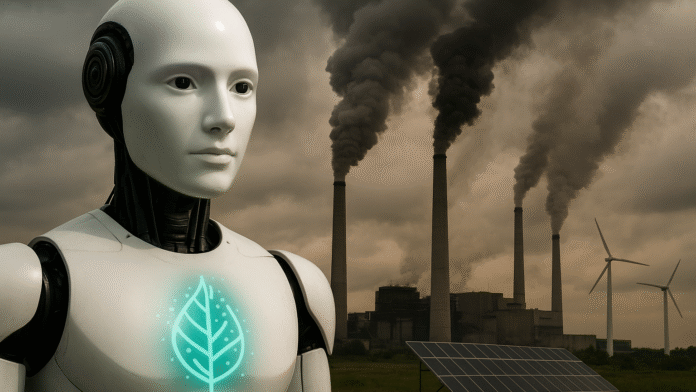

The Climate Cost of Intelligent Machines
Artificial intelligence has been heralded as the defining technology of the 21st century, a tool capable of transforming industries, accelerating drug discovery, optimizing energy systems and even predicting climate patterns. Yet beneath the promise lies a growing environmental paradox: AI may be one of the most energy-intensive technologies ever created. As society accelerates toward automation and smart systems, a critical question emerges, can AI truly be part of the climate solution, or is it quietly becoming a carbon catastrophe?
The foundation of AI is energy, vast, unrelenting energy. Training large-scale language models, powering real-time recommendation engines and processing massive datasets demand enormous computational capacity. Data centers, the physical backbone of AI, consume nearly as much energy annually as the entire United Kingdom. According to recent estimates from the International Energy Agency, global data center energy consumption could double by 2026, largely driven by AI adoption. The carbon footprint of training a single large AI model can equal the lifetime emissions of five average cars, challenging the image of AI as an inherently clean digital technology.
This invisible energy footprint is further complicated by its dependence on fossil fuels. Much of the world’s data center infrastructure is located in regions still powered by coal and natural gas. Even tech giants that claim carbon neutrality often rely on carbon offsets rather than direct emissions reductions. Renewable-powered data centers remain more of a branding exercise than a global standard. As AI adoption expands into developing economies with weaker energy infrastructure, the risk is that the world locks itself into a high-emission digital future.
However, to dismiss AI as an environmental villain would ignore its extraordinary potential as a climate ally. AI has already proven transformative in renewable energy optimization. Machine learning models help balance wind and solar energy with demand, reducing power grid losses and cutting reliance on backup fossil fuel plants. AI-driven climate models are producing higher accuracy predictions for extreme weather, giving governments more time to plan evacuations and protect infrastructure. In agriculture, AI tools are enabling precision farming, reducing water usage and fertilizer emissions while increasing crop resilience. The technology carries real power to accelerate sustainability, if directed responsibly.
The divide between AI’s promise and its environmental cost is not technological but strategic. Governments and corporations have prioritized performance over sustainability, racing to build larger, more complex AI systems without measuring their environmental impact. Few AI companies disclose energy consumption, and there are no global standards for “green AI.” The tech industry currently treats energy efficiency as an afterthought rather than a design principle.
The path forward demands a shift in priorities. First, AI development must include transparent emissions reporting. Second, research funding should support energy-efficient algorithms and hardware designed to reduce computation demands. Third, governments must enforce renewable energy sourcing for major data operations to prevent AI from expanding fossil fuel dependency. Finally, a global policy framework is needed to align AI growth with climate targets.
AI will shape the future of civilization, but whether it accelerates climate solutions or amplifies environmental damage depends on decisions made now. The world has a narrow window to ensure AI evolves responsibly. Green AI is possible, but without intentional design and policy direction, the future of artificial intelligence may be powered not by innovation, but by coal.